
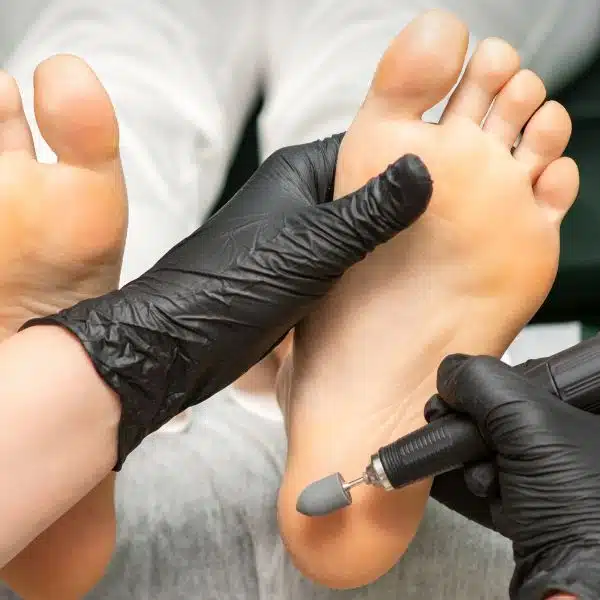
Corns and calluses are common foot problems caused by repeated pressure or friction. They develop when the skin thickens to protect itself, usually in areas that are being rubbed by shoes, pressed by the way you walk, or overloaded during daily activities.
Although corns and calluses are not usually serious, they can become uncomfortable, painful, or difficult to manage if the pressure continues. The best treatment for corns and calluses depends on what you have, where it is, how painful it is, whether it keeps coming back, and whether you have any underlying health conditions such as diabetes, poor circulation or reduced sensation in your feet.
If you want a broader explanation of what causes corns and calluses, our full guide covers the symptoms, differences and common causes in more detail. Here, we’re focusing specifically on treatment options.
Best Treatments For Corns And Calluses At A Glance
There is no single best treatment for every corn or callus. A mild patch of hard skin on the heel may need a different approach from a painful corn on the toe or a recurring callus under the ball of the foot.
Here’s a quick guide:
| Treatment | Treatment | Be Careful If |
| Footwear changes | Corns or calluses caused by tight, loose or rubbing shoes | Pain continues despite changing footwear |
| Padding and pressure relief | Short-term comfort and reducing rubbing | Padding makes shoes tighter or increases pressure |
| Moisturising and urea creams | Dry, thickened or callus-prone skin | Skin is cracked, bleeding or irritated |
| Salicylic acid products | Some uncomplicated corns or calluses | You have diabetes, poor circulation, fragile skin or reduced sensation |
| Soaking and gentle filing | Mild hard skin | The area is painful, open, cracked or bleeding |
| Podiatry treatment | Painful, recurring, severe or unclear corns and calluses | You are unsure what the hard skin actually is |
For mild hard skin, careful callus removal at home may help. For painful, recurring, cracked or stubborn hard skin, professional podiatry treatment is usually the safer route.
Corns Vs Calluses: Why Treatment Differs
Corns and calluses may appear similar, but they are not quite the same.
Corns are usually smaller, rounder areas of thickened skin. They often appear on the tops or sides of toes, between toes, or over bony pressure points. A corn may have a firm centre and can feel sharp, tender or painful when pressed.
Calluses are usually broader and flatter. They often form on weight-bearing areas, such as the heel, the ball of the foot, or underneath the big toe joint. Calluses may be painless at first, but they can become sore, cracked or tender as the hard skin builds up.
This matters because treating both in exactly the same way does not always work. A callus caused by pressure under the foot may improve with cushioning, moisturising and reducing hard skin gradually. A painful corn caused by a toe rubbing against a shoe may need pressure relief, footwear changes, and professional reduction of the hard skin.
If you are not sure whether you have a corn, callus, verruca, or another foot problem, it is better to have the area checked rather than repeatedly treating the wrong thing.
What Causes Corns And Calluses To Need Treatment?
Corns and calluses form because the skin is trying to protect itself. The problem is not usually the hard skin alone. The real issue is the pressure or friction causing that hard skin to develop.
Common causes include:
- Shoes that are too tight
- Shoes that are too loose
- Narrow toe boxes
- High heels
- Hard soles
- Long periods of standing
- Walking long distances
- Running, dancing, hiking or other repetitive activities
- Walking barefoot on hard surfaces
- Bunions, hammer toes or other toe changes
- Flat feet, high arches or changes in gait
Foot structure can make a big difference. Flat feet, fallen arches, high arches or ongoing arch pain can change how pressure moves through the foot. That pressure may then build in one specific place, causing a corn or callus to return even after it has been treated.
If the discomfort is worse when you are walking, the corn or callus may be part of a wider pressure pattern. In some cases, hard skin can contribute to foot pains when walking because you may start changing the way you walk to avoid the sore area.
Footwear Changes
One of the most important treatments for corns and calluses is reducing the pressure that caused them in the first place. This often starts with footwear.
Shoes that are too tight can squeeze the toes and create pressure points. Shoes that are too loose can allow the foot to slide around, causing friction. High heels can increase pressure through the forefoot, while narrow or pointed shoes can encourage corns on the toes.
Choosing better footwear can help by giving your toes more space, reducing rubbing, and spreading pressure more evenly across the foot.
Look for shoes with:
- A wide, comfortable toe box
- A low heel
- A soft sole
- Enough depth for your toes
- Good cushioning
- Secure fastening so your foot does not slide around
- No seams or pressure points rubbing the affected area
This may sound simple, but footwear changes can be one of the most effective long-term treatments because corns and calluses often come back if the same pressure keeps happening.
Padding And Pressure Relief
Padding can help protect sore areas and reduce friction while the skin settles. This may include corn pads, gel pads, moleskin, toe separators, foam wedges, insoles or heel pads.
Padding is especially useful when the hard skin is being irritated by shoes or by pressure from a neighbouring toe. It can also help reduce discomfort from painful calluses on feet, particularly when the pain is caused by concentrated pressure under the foot.
However, padding needs to be used carefully. If it makes your shoes tighter, changes how your foot sits, or increases pressure around the corn or callus, it may make the problem worse rather than better.
Padding can provide relief, but it is not always a full solution. If a corn keeps coming back, the question is not just “how do I remove it?” The question is “why is this exact spot being overloaded?”
Moisturising And Urea Creams
Moisturising is one of the simplest ways to care for hard skin. Dry skin is more likely to become rough, cracked and uncomfortable, so keeping the skin soft can help reduce build-up and improve comfort.
Foot creams for corns and calluses often contain ingredients such as urea or other emollients. Urea-based creams can help soften thickened, dry skin and improve the skin’s flexibility. They are often more useful for broader areas of callus than for a deep, painful corn with a concentrated centre.
A cream can help soften hard skin, but it will not remove the underlying pressure. This is why creams work best as part of a wider treatment plan that also includes footwear changes, cushioning and regular foot care.
For best results, apply foot cream after washing and drying your feet. Many people find it helpful to apply a thicker layer at night and wear clean cotton socks to help the cream absorb.
Do not apply cream between your toes unless advised by a professional, as excess moisture between the toes can sometimes lead to other skin problems.
Corn Removal Creams
Corn removal creams can sound like the easiest answer, especially when a corn is painful and you want it gone quickly. However, it is important to be realistic about what these products can and cannot do.
Some products are designed to soften thickened skin so it can be reduced more easily. Others contain stronger active ingredients intended to break down hard skin. These may help in some simple cases, but they are not suitable for everyone.
A corn removal cream may be worth considering if:
- The corn or callus is mild
- The skin is not broken or bleeding
- You do not have diabetes or poor circulation
- You have normal sensation in your feet
- You are confident it is a corn or callus
- You follow the instructions carefully
A cream is less likely to solve the problem if the corn is deep, very painful, recurring, or caused by a structural pressure point. In those cases, the cream may soften the surface while the cause remains firmly in place, lurking underneath like the final boss in sensible shoes.
Salicylic Acid For Corns And Calluses
Salicylic acid is a common ingredient in some over-the-counter treatments for corns and calluses. It works by softening and breaking down thickened skin so it can be removed more easily.
You may find salicylic acid in:
- Corn plasters
- Medicated pads
- Liquids
- Gels
- Ointments
Salicylic acid can be useful for some uncomplicated corns and calluses, but it is not risk-free. If it spreads onto healthy skin, is used too often, or is applied to fragile or broken skin, it can cause irritation or damage.
You should avoid salicylic acid products unless advised by a professional if you have:
- Diabetes
- Poor circulation
- Reduced sensation in your feet
- Fragile skin
- Cracked or broken skin
- A wound near the corn or callus
- Signs of infection
- Uncertainty about what the hard skin actually is
If you have diabetes and are dealing with hard skin, pressure areas, or diabetic foot pain, it is safer to seek podiatry advice rather than using medicated corn plasters or acid-based treatments.
If you are considering stronger at-home treatments, it is worth understanding the risks of DIY corn and callus removal first. The aim should be to reduce hard skin safely, not damage the healthy skin around it.
Soaking And Gentle Exfoliation
Soaking and gentle exfoliation can help with mild hard skin, particularly when the callus is broad, dry and not painful.
Soaking your feet in warm water for around 10 to 15 minutes can soften the skin. After soaking, you can gently use a pumice stone or foot file to smooth the affected area. The key word is gently. You are not trying to remove the whole callus in one dramatic bathroom excavation.
Stop if the area becomes painful, red, sore or irritated. Over-filing can damage healthy skin and make the area more uncomfortable.
After filing, moisturise the skin to help keep it soft. This works best when done consistently and combined with reducing the pressure that caused the hard skin in the first place.
If you want more detail on safe technique, our guide to callus removal at home explains the safer ways to manage mild hard skin without using sharp tools.
Professional Podiatry Treatment
For painful, recurring or stubborn corns and calluses, podiatry treatment is often the best option.
A podiatrist can assess the type of hard skin, check what is causing it, and reduce the thickened skin safely where appropriate. They can also look at your footwear, gait, foot shape and pressure points to help stop the problem returning.
Professional treatment may include:
- Safe reduction of thickened skin
- Corn removal where appropriate
- Padding or strapping to reduce pressure
- Advice on footwear
- Insoles or orthotics
- Advice on creams and skin care
- Checking for other foot problems
- A longer-term prevention plan
This is especially important if the corn or callus is painful, bleeding, cracked, infected, or affecting the way you walk.
You should also see a podiatrist if you are not sure whether the problem is definitely a corn or callus. Hard skin can sometimes hide another issue, and treating the wrong problem can delay proper care.
When Corns Keep Coming Back
If your corn or callus keeps returning after treatment, it usually means the underlying pressure has not been resolved.
Over-the-counter treatments, creams and filing may reduce the hard skin temporarily, but they cannot always change the reason that area is being overloaded. This is why some people feel as though they are treating the same painful spot again and again.
Recurring corns and calluses may be linked to:
- Tight shoes
- Toe deformities
- Bunions
- Hammer toes
- High arches
- Flat feet
- Fallen arches
- Uneven weight distribution
- Abnormal gait
- Loss of natural cushioning under the foot
- Long periods standing or walking
In some cases, strengthening and mobility work may help support better foot function. General foot and ankle exercises will not remove a corn or callus by themselves, but they may help with stability, mobility and pressure distribution as part of a broader foot-care plan.
A podiatrist can assess whether custom insoles, orthotics, padding or footwear changes may help reduce the pressure and break the cycle.
When Hard Skin Pain Might Be Something Else
Most corns and calluses are caused by pressure and friction, but not every painful area of hard skin is straightforward.
A verruca can sometimes develop hard skin over the top and be mistaken for a corn. Pain in the ball of the foot can also come from deeper structures, not just the skin. Heel pain can be confusing too, because hard skin on the heel may be present at the same time as another issue.
If the pain feels deeper than the hard skin, affects the way you walk, or is not clearly linked to one patch of thickened skin, it may be useful to consider the broader causes of foot pain.
Hard skin on the heel is often linked to pressure, dryness or footwear, but ongoing sore heel pain may have another cause, particularly if the discomfort feels sharp, deep or worse first thing in the morning.
When in doubt, get it checked. Guesswork and feet make a terrible double act.
Common Misconceptions About Corn And Callus Treatment
There is a lot of bad advice about corns and calluses, and some of it can cause more trouble than the original hard skin.
“You can just cut it off”
Do not cut corns or calluses yourself with scissors, razors, knives, blades or nail clippers. It is easy to cut too deeply, damage healthy skin, cause bleeding or introduce infection.
This is especially risky if you have diabetes, poor circulation, reduced sensation or a weakened immune system.
“Corn plasters are safe for everyone”
Medicated corn plasters often contain acid-based ingredients. These may be suitable for some people, but they can irritate or damage surrounding skin if used incorrectly.
They are not suitable for everyone, and people with diabetes, poor circulation or reduced sensation should seek professional advice before using them.
“Creams fix the cause”
Creams can soften hard skin and improve dryness, but they do not fix pressure from shoes, toe position, gait or foot structure.
If the same pressure remains, the corn or callus can come back.
“Corns and calluses are basically the same”
They are both areas of thickened skin, but they often behave differently. Corns are usually smaller, deeper and more painful. Calluses are usually broader and flatter. Choosing the right treatment depends on knowing which one you have.
“If it comes back, the treatment failed”
Not necessarily. If the hard skin was removed but the pressure remained, recurrence is likely. In that case, the missing piece is not more aggressive removal. It is pressure reduction.
So, What Is The Best Treatment For Corns And Calluses?
The best treatment depends on the situation.
If you have mild hard skin, the best starting point is usually gentle home care. This may include warm water soaking, careful filing, moisturising and changing your footwear.
If you have a corn caused by shoe pressure, the best treatment is usually to reduce the rubbing. This may involve wider shoes, padding, toe protection, or podiatry treatment if the corn is painful or deep.
If you have a callus under the foot, the best treatment usually focuses on pressure reduction. Moisturising, gentle filing and cushioning may help, but recurring calluses often need footwear or gait assessment.
If the area is painful, professional treatment is usually the safest option. This is especially true if you have painful calluses on feet, pain when walking, or hard skin that keeps coming back in the same place.
If you have diabetes, poor circulation, reduced sensation, fragile skin, bleeding, cracking or signs of infection, do not treat corns and calluses yourself. Book an appointment with a podiatrist or speak to a medical professional.
If you are unsure what it is, do not guess. The best treatment starts with the right diagnosis.
Preventing Corns And Calluses From Returning
Once the hard skin has been treated, the next step is stopping it from coming back.
Prevention usually means reducing pressure and friction. This may include:
- Wearing shoes that fit properly
- Choosing wider, softer shoes
- Avoiding high heels or tight pointed shoes
- Wearing thick, cushioned socks
- Using insoles or heel pads
- Moisturising regularly
- Gently filing mild hard skin before it builds up
- Checking your feet regularly
- Seeing a podiatrist if the same area keeps causing problems
If prevention fails and the same corn or callus keeps returning, it is a sign that the underlying pressure still needs attention.
When Should You See A Podiatrist?
You should consider seeing a podiatrist if:
- Your corn or callus is painful
- It keeps coming back
- It is affecting the way you walk
- The area is cracked, bleeding, swollen or producing discharge
- Home treatment has not helped
- Salicylic acid or corn plasters have irritated your skin
- You are not sure whether it is a corn, callus, verruca or another problem
- You have diabetes
- You have poor circulation
- You have reduced sensation in your feet
- You are worried about cutting or damaging the skin
A podiatrist can safely reduce hard skin, identify the pressure causing it, and recommend a treatment plan that is suitable for your feet.
One Last Thing…
Corns and calluses are common, but that does not mean you have to keep putting up with them. The best treatment is not always the strongest product or the quickest removal method. Often, the best treatment is the one that deals with the pressure causing the problem in the first place.
For help treating your corns and calluses, get in touch or drop into our Northwich clinic. We’ve been happily helping the residents of Cheshire be rid of their corns for many years.
FAQs
What are the most effective treatments for corns on feet?
The most effective treatments for corns usually involve reducing pressure first. This may include better-fitting shoes, protective padding, toe separators, insoles or professional podiatry treatment. Some over-the-counter products may help in simple cases, but painful or recurring corns should be assessed by a podiatrist.
What is the best treatment for calluses?
The best treatment for calluses depends on how thick, painful or recurring they are. Mild calluses may improve with moisturising, gentle filing and footwear changes. Painful, cracked or stubborn calluses may need professional reduction and pressure-relief advice from a podiatrist.
Is salicylic acid good for corns?
Salicylic acid can help soften thickened skin in some uncomplicated corns, but it is not suitable for everyone. It should not be used on broken, cracked, fragile or infected skin, and people with diabetes, poor circulation or reduced sensation should avoid it unless advised by a professional.
What is the best corn removal cream?
The best corn removal cream depends on your skin, the type of corn, and whether you have any underlying foot-health risks. Urea-based creams can help soften dry, thickened skin, while some corn treatments contain stronger ingredients such as salicylic acid. If the corn is painful, deep or recurring, cream alone is unlikely to fix the cause.
How can I treat corns at home in the UK?
For mild corns, you may be able to reduce pressure with better footwear, padding and careful skin care. Avoid cutting the corn yourself. If you are using over-the-counter treatments, follow the instructions carefully and stop if the skin becomes sore or irritated. If you have diabetes, poor circulation or reduced sensation, do not self-treat.
Can podiatrists help with callus removal?
Yes. Podiatrists can safely reduce thickened skin, relieve pressure, assess why the callus has formed, and advise on footwear, padding, insoles or orthotics to reduce the chance of it returning.
Should I cut off a corn or callus?
No. You should not cut off a corn or callus yourself. Using scissors, razors, knives or nail clippers can damage healthy skin and increase the risk of infection. This is especially risky if you have diabetes, poor circulation or reduced sensation.
Why do my corns keep coming back after treatment?
Recurring corns usually mean the original pressure or friction is still there. This may be caused by shoes, toe position, bunions, hammer toes, gait issues, arch problems or uneven weight distribution. A podiatrist can assess the cause and recommend ways to reduce the pressure.
Are over-the-counter treatments for corns safe for everyone?
No. Over-the-counter treatments are not suitable for everyone. People with diabetes, poor circulation, reduced sensation, fragile skin, cracked skin or signs of infection should seek professional advice before using corn plasters, salicylic acid or other medicated products.
What are the risks of untreated corns and calluses?
Untreated corns and calluses can become more painful over time. They may crack, bleed, affect the way you walk, or increase the risk of skin breakdown. This is particularly important for people with diabetes, poor circulation or reduced sensation, where small foot problems can become more serious.


